OVO - Direct Debit FAQ

OVO is an energy provider, they supply gas and electricity to millions of customers across the UK. I joined OVO in September 2022 during the energy crisis. Where they were having issues with the best ways to communicate the complex ways customers direct debit, debit debit check-ins/reviews and credit is calculated, this was an issue OVO was aware of for may years, however, the crisis escalated this issue.

The DDR FAQ is a project I have spent a lot of my time at OVO working one, it started off as a quick win and then became a multi-team effort to tackle comprehension and answer customers most FAQ.

The problem

DD FAQ

What is Direct Debit review (DDR)?

DDR is a process that customers enter every few months, a customer enters the process it checks if they are paying the accurate amount. If they are the payment remains the same, if they are not paying the accurate amount than it automatically adjusts their Direct Debit to the accurate amount based on usage.

The aim of DD is to stop customers from receiving a huge bill at the end of their contract with OVO.

There are a number of reasons customers can end up in DDR:

  • Customers are using more energy than they are paying for
  • Customers missed a payment and/or payment bounced
  • Customers change tariff and their Direct Debit payment has not

*This explanation directly relates to the work conducted.

I was originally tasked with tackling the issues OVO was experiencing with customers not comprehending how their Direct Debit worked. This resulted in high volumes calls, on a average month 23% of calls were Direct Debit comprehension rated and would increase to approximately 45% on the 1st and 15th of the month, when comms to inform customers of a Direct Debit increase would be sent out.

We initially thought it was a Direct Debit comprehension problem,  until I conducted some primary research based on data OVO has internally – and this is what I found:

  • Customers looked for the information online first, when they could not find the information they called customer service.
  • Customers were confused why their Direct Debit always increased but never decreased.
  • Customers Direct Debit would increase even with a substantial amount of credit on their accounts – These customers could not understand why OVO could increase their Direct Debit instead of using their credit.
  • Customers with credit would accuse OVO as asking like a bank as they were not happy with OVO credit policy.
  • Customers who could not afford the new Direct Debit increase would call to reduce or keep their Direct Debit amount the same.
  • Some customers simply did not want their Direct Debit to be increased and would rather pay a lump sum up-front.
  • Customers were questioning the way OVO calculated their Direct Debit increase.
  • When Customers think they are loosing control of their finances they cancel their Direct Debit.
  • Customers call because the comms tells them too.

The above made it apparent that the problem was not the fact that customers did not understand Direct Debit or the DDR process, but the fact they had genuine questions and concerns regarding their money, account, credit and couldn’t find the answers.

At the time I was the only person in the team, (and within a few weeks – months a project manager and UX Researcher joined the team.) I categorised 4 months worth of NPS scores and comments from customers who had called into customer service.

When “E” the UX Researcher joined the team, we decided that we needed more information and/or data before we could ideate. We quickly came across a year old research desk that was looking at the same issue we were. The UX Researchers on that team spoke to 15 participants.

The main takeaways from the study:

  • Customers want more control over their payments
  • Customers want more information regarding the reason OVO believes their Direct Debit could be increased?
  • Customers did not understand that if they did not increase their Direct Debit they would be in debit by the end of the contract.

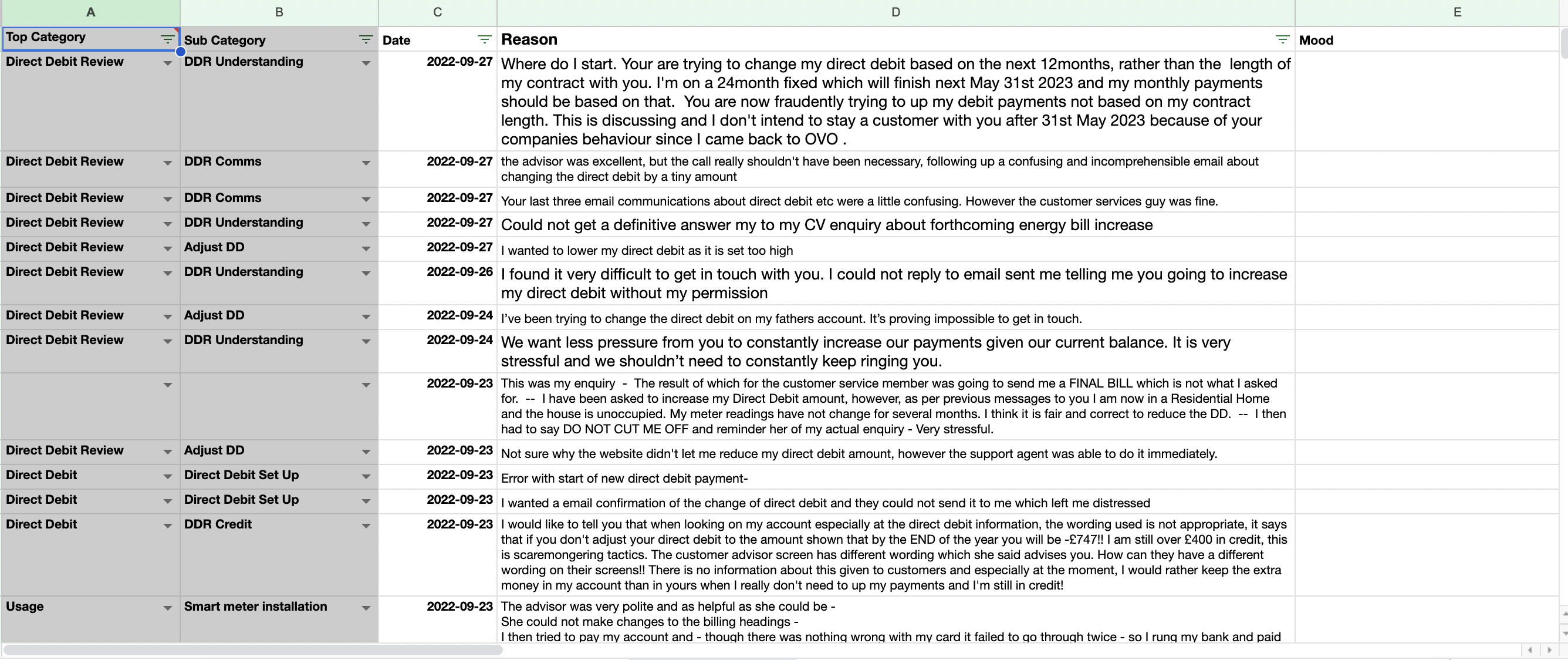
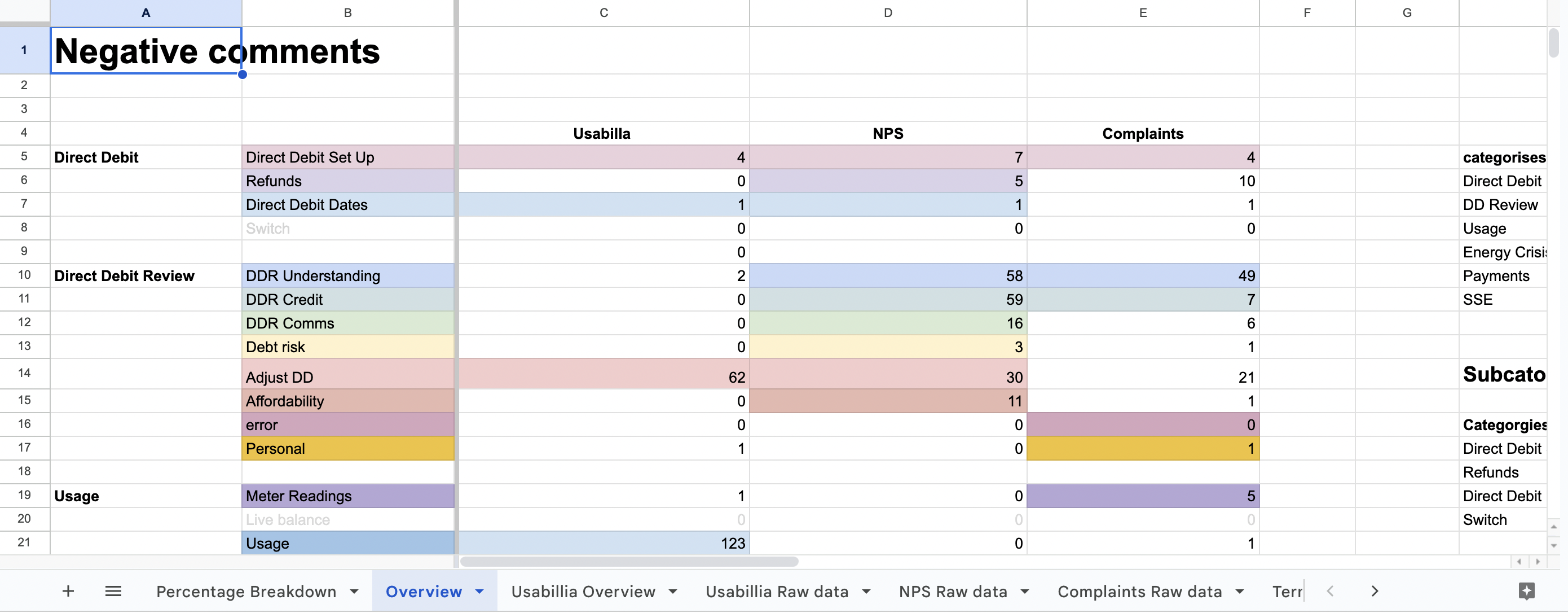
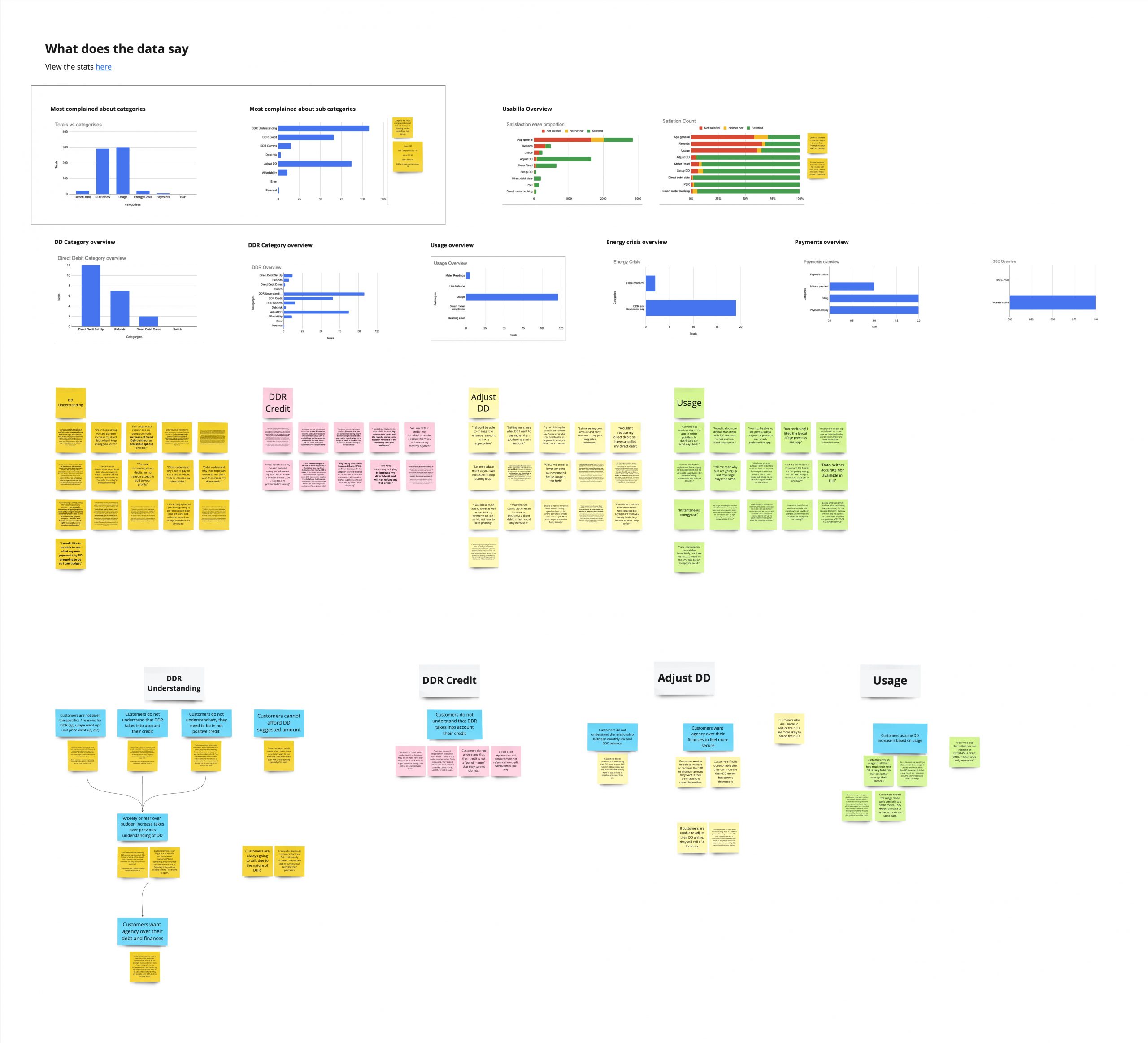
At this point we decided not to conduct any interview, as we had everything we needed, but we wanted more data, so we put together a rainbow spreadsheet with all the complaint data, NPS and Usabilia comments we could find that related to our domain.

The above image allowed us to put together the below graphs to better understand the issues customers were facing.

DDR stats

Sent email to say don’t increase direct debit as I will sort out any differences at the end as these are estimated figures. I was advised to contact you

The challenge

The quick win

Once we had all the data, we all ideated idea, high-level the best ideas that came forth were:

  • A real-time graph that showed customers what they were using and predicted their usage by the end of the month to stop customers from entering DDR initially.
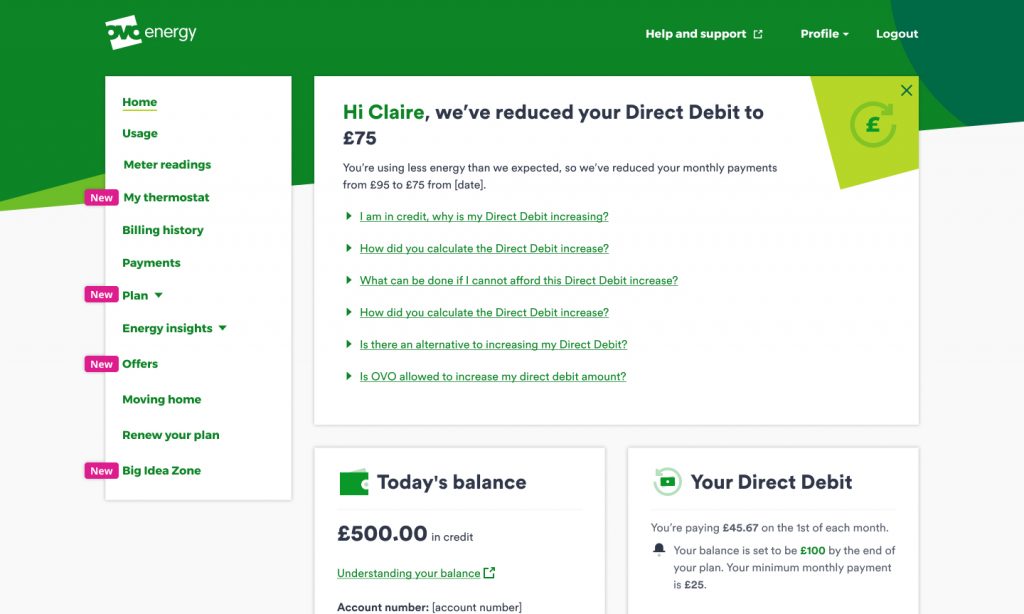
  • A personalised FAQ with a CTA on the app and web portals landing page advising customers that they had entered into DDR and the reasons behind this.

Our PM asked that we go with the FAQ as it was thought to be a quick win and at the time it was predicted that government would drop the price cap in April 2023 (it never happened). OVO were worried that if this happened also all customers would enter into DDR review causing mass panic and the FAQ could potentially prevent this.

Our goal for the project was to create a online experience that would help customers to understand:

  • Their specific scenario and understand why their account will need to be increased.
  • What can be done if the customer is having financial problems (such as apply for a payment plan online or payment help OVO offers online)
  • Their usage, reasons for increase and keep within the loop and not outside of it at all times.

Up until now all article or information online were extremely generic and were not personalised or that helpful to customers. From research we already knew customers looked online first, many of them stating that they tired to avoid calling as they did not want to be held in long queues.

My Role

I was the lead designer on this project. I led the entire design process, from discovery to creating the High Fidelity mockups and prototypes to hand-off to the developer.

In addition, I worked alongside the Content designers, Data Analyst, Product Managers, User Researchers and Developer.

As I am £972 in credit I was surprised to receive a request from you to increase my monthly payment

Design

Questions, Wireframes & mockups

Questions

We wanted to find out what questions customers were asking an how often they were asked. So we spent time with the customer care team and used data collected from incoming calls to find out what customers were asking as these are the questions, statements and data we found customers wanted answered:

What is the reason my Direct Debit is increasing?

Customers wanted to know the exact reason behind the increase and were not happy with generic answers.

How did you calculate the increase?

Customers often came up with their own calculations, that were different from OVOs – so there were often differences so customers wanted to know the exact calculation.

I do not want my Direct Debit to increase because I am in credit

I cannot afford this increase

I want to make a payment instead of increasing my DD

I do not understand my billing, can you explain?

Is this a legal practice?

Why has my DD gone up?

Many of these questions we also found in our rainbow spreadsheets raw data.

Wireframes & mockups

Due to OVO having a mature design system, it was very easy to work out what these designs would look like. However, the choice I had to make was were mobile and desktop going to work the same or work completely differently. I also had to keep in mind that two completely different teams owned the different experiences and they were not connected at all. So it wasn’t going to cause dev extra work if I decided that they were going to work differently.

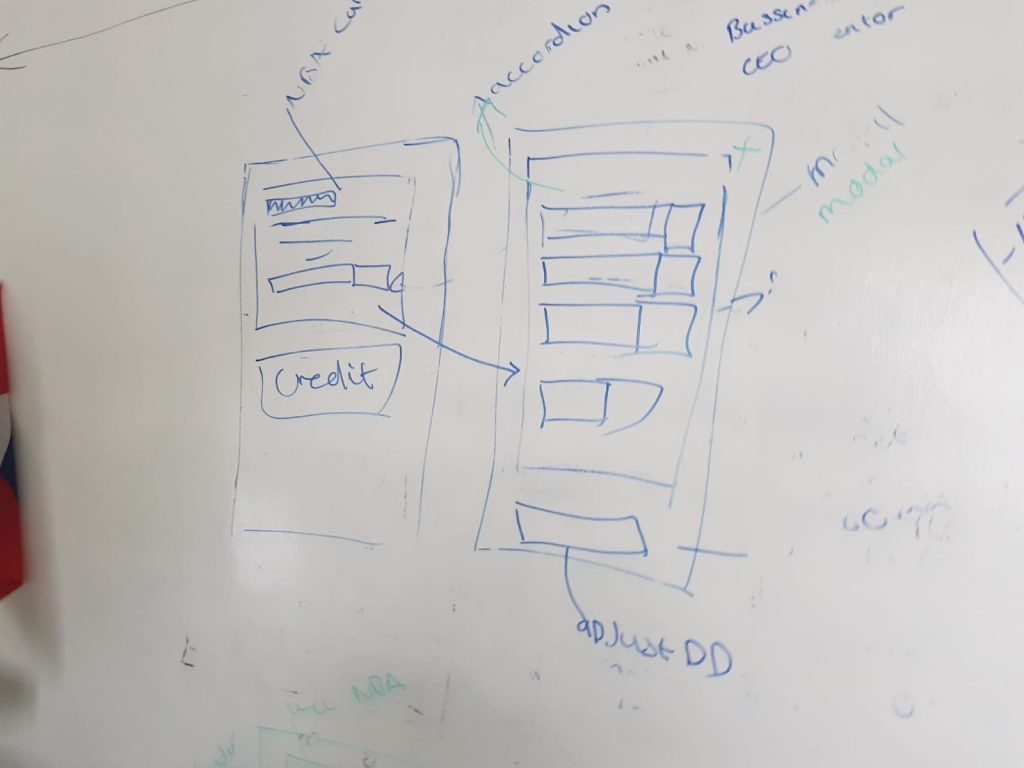
I started by wireframing mobile as I already had an idea what they should look like. Whilst keeping existing patterns such as the card that appears on landing the same. I also knew OVO was creating a new design system which it has been decided that all level 2 interactions would be in a modal. So this choice was already made.

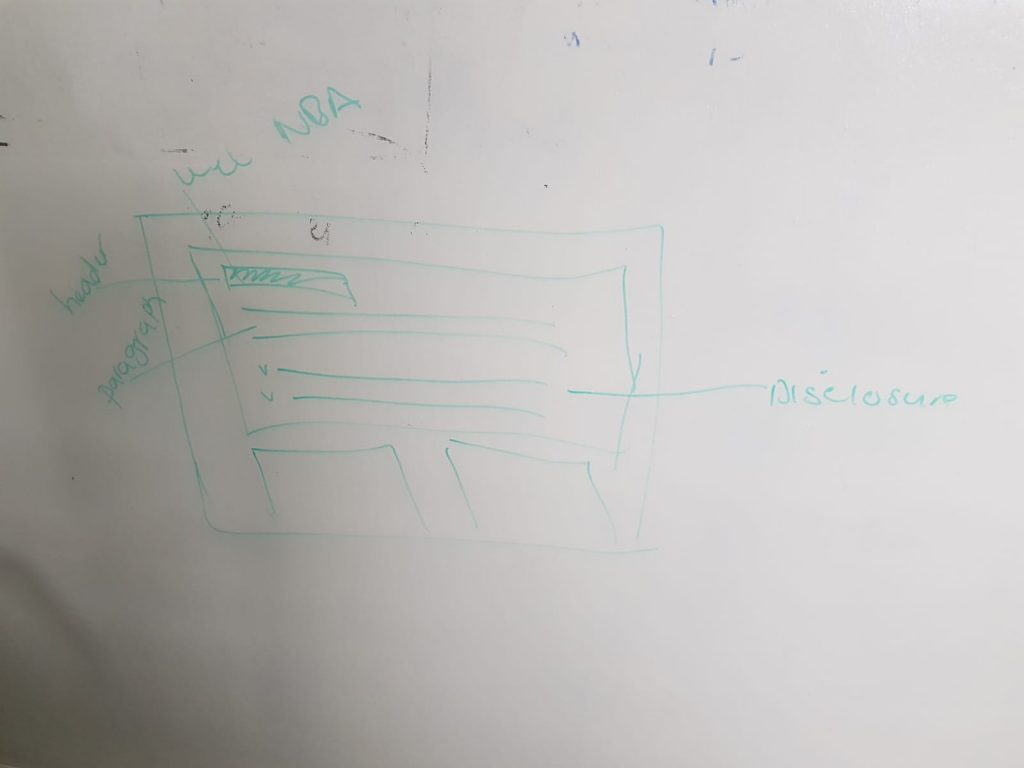
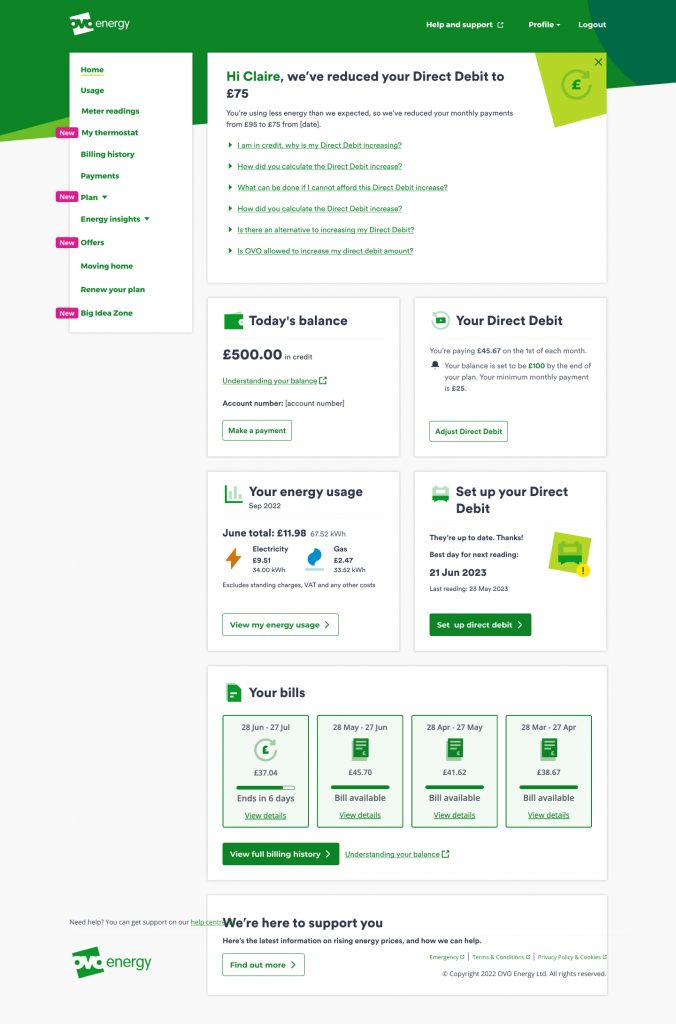
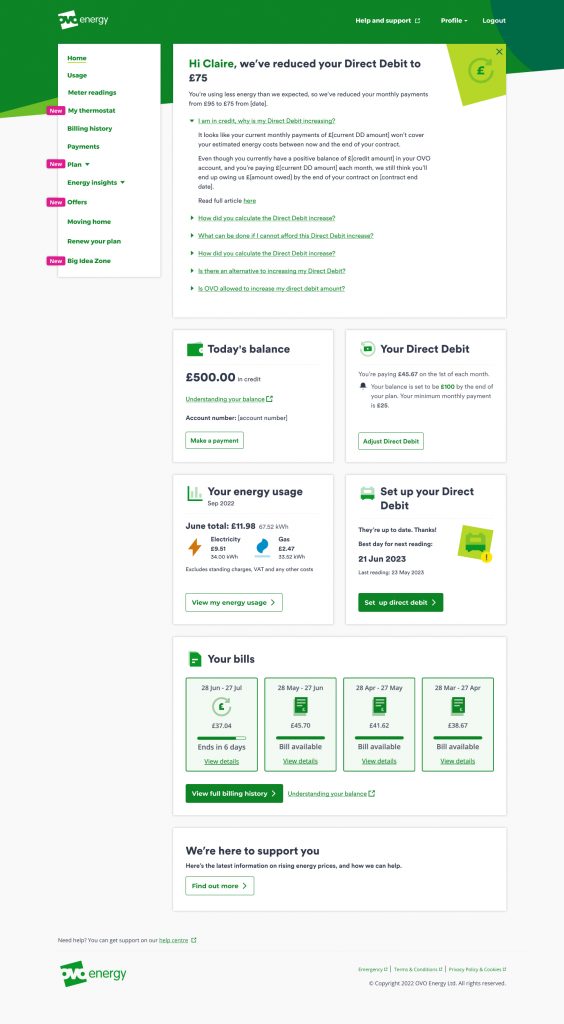
On Desktop, I considered during a modal also, but also considered what if we we thought the card. Unlike on mobile the “NBA” card had not been established, but it had rules as was a think on mobile already. So this gave me the opportunity to rethink the wheel. It later turned out that another team was working on a similar concept so we worked together to come up with what  NBA card for answering personalised questions would look like.

Wiframes
Mobile wireframe
Desktop wireframe
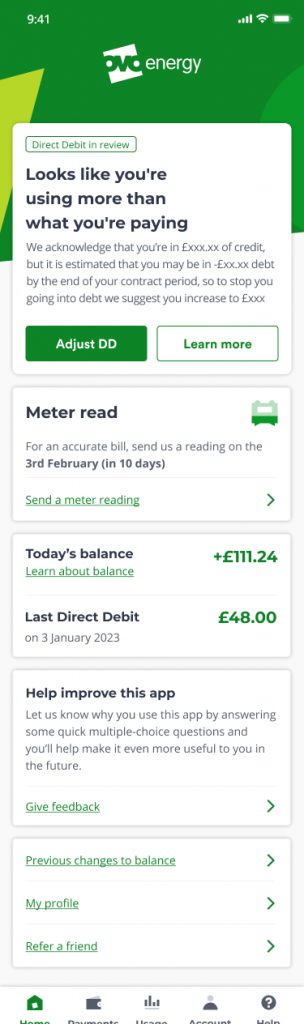
Mockups (Mobile)
Home
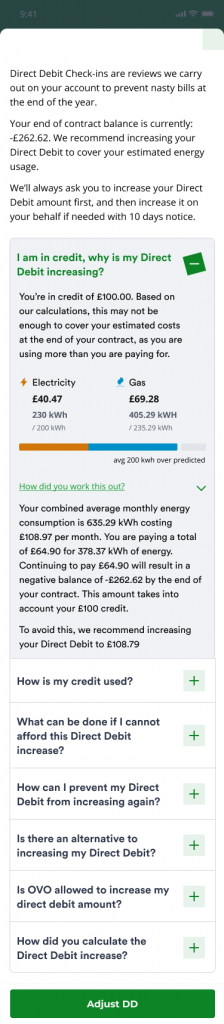
Why is my DD increasing?
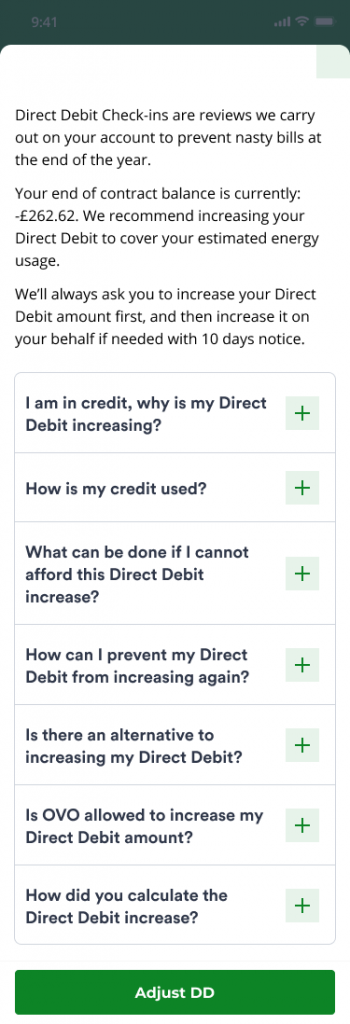
FAQ Landing
Mockups (Desktop)
Discovery

User Testing

We found that there is ample research and hypotheses on what drives customers under review to call agents. The existing research confirms our general understanding around dd customers, though the following additional research could help define interventions areas:

Further exploratory research to understand specific experiences of each customer segments. This will help us narrow down which customer segment to target, and what interventions would be most effective.

Evaluative research on potential design interventions. There are many potential UI designs and bill designs that have not been tested or implemented. Some evaluative research that test our understanding can help us refine and update our hypotheses.

During the problem identification, we were able to identify key problem areas by reviewing existing research and qualitative data. We also had a hypothesis and  intervention on the app to curve customer agent calls regarding ddr.

In order to test our hypotheses and the effectiveness of the prototype, we decided to conduct some research. We also wanted to conduct research to have additional insight on our customers behavior around ddr, to narrow down on  the most effective intervention. At the same time, we wanted to test the engagement and success  of the prototype to ensure we are using our time and resources meaningfully and efficiently.

Customers were sensitive to wording

Customers seem to be particularly sensitive around the vocabulary and tone choices used that pertain to DDR. It was brought up multiple times that the fact that the DDR modification amount is a ‘suggestion’ is misleading. When  customers try to decrease the suggested amount they quickly realize they are unable to and that OVO will increases their direct debit amount automatically. This renders OVO’s suggestion to be dishonest, indirect and unclear.

A couple participants also pointed out the fear that words like ‘nasty bills’ can bring out and prefer more neutral terms like ‘larger bills.’Updating and reviewing the vocabulary choices around DDR related communications may improve the experiences of OVO customers in making them feel they can trust and feel safe with OVO.


An accurate and clear personalised faq could improve ddr comprehension and trust

Most participants thought that having a visual,  personalised cost breakdown of direct debit amount would be helpful in cross-referencing the suggest direct debit amount with their usage. Particularly given that they receive various communications regarding their ddr, having the go-to personalised calculations with the most frequent data could make this the most reliable calculations that both customers and agents could refer to. They also thought that the content of the questions, were in general, quite useful. Many of them were not aware of the different payment options, reasons for being asked for credit, and the legality around OVO increasing direct debit amounts.


Customers who previously had agent contact were more likely to contact agents immediately before interacting with the FAQs. As agents have previously lowered their Direct Debit. 

Many customers who previously contacted customer agents to dispute their dd amount or gain clarification on the calculations did not immediately accept the dd amount suggestion. However, once they did read through the FAQ, a few participants said they would go ahead and adjust their dd without contacting customer agents. If we can drive some customers who are likely to contact agents to interact with the faq, we may curve some agent calls.


If customers find DD increase unfair or incorrect, they may still call agents in order to rebut or explain personal circumstances.

For example, even after participants engage with the FAQ, they may still call customer agents to lower their direct debit amount based on their efforts in minimising usage. They feel like they have no choice but to call agents, as it is  something that they are currently unable to do on the app, but may be possible with the agents.


20% of customers agreed to change their DD based on the information in the FAQ, once they arrived at the adjust DD page they stated they would call customer care.

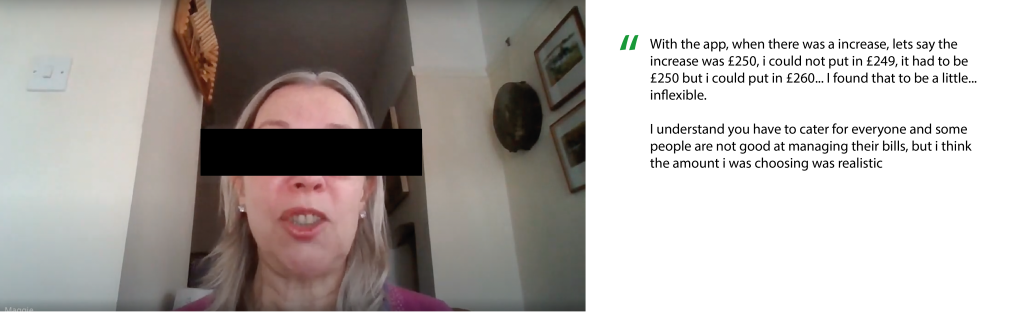
Participants were mostly willing to change their DD online, however, once some of they arrived at the adjust DD page and realised they had no agency or flexibility to choose their payment they stated they would call customer care as they would want to change their DD to amount that made sense to them. Customers mostly wanted to pay a figure of £5 of less then the recommended amount but online they can online pay the recommended amount or higher. From previous experience customers know they can usually get customer care to reduce their DD to amount they want.

Based on feedback, we have hypothesised that the DDR FAQ could likely reduce contact by 40-60% but customers will always call, unless we can find a way to have a two-way communication feed which does not require customer care to operate, mostly something similar to ChatGPT.

We worked out the changes that are required on each screen to be better meet customers, which were mostly content based. As the content was very technical and compliance based we asked to have a content designer specially for our team as there was only so a designer and researcher could do.

We also asked for a ideation session to be had with the stakeholders so we could talk about further pressing decisions such as:

  • The adjust DD page lack of flexibility
  • Customer care adjust DD based on their own discretion which is causing UX issues due to lack of defined rules
Discovery

What happened next?

Currently the project is on pause, as OVO had a number of priority projects that the team had to work, many of which were specified by the CEO na Ofgem (Energy ombudsman).

However, delays are not always a bad thing, as whilst we are working on this OVO has decided to change their DDR process, which will now include:

  • Increase and decreases (It once only included increases)
  • Returning credit to customers who have huge credit on account and potentially lowering their DD
  • One comms DDR process
  • Retraining customer care team

All the above are things that caused huge UX issues, which were not controlled or in scope for the product team. When we return to this project it is likely that the huge UX issues the team was concerned about may be a thing of the past. Resulting in a better UX for csustomers.